
Molecular fundamentals
Peptides vs. Proteins: What’s the Difference?
Peptides and proteins are built from amino acids. Peptide generally describes a shorter chain; proteins consist of one or more polypeptide chains with molecular organization that supports their functions. These terms describe related structures, not competing classes of laboratory material.
Shared chemistry: amino acids and peptide bonds
Both peptides and proteins contain amino-acid chains. A peptide bond joins the carboxyl group of one amino acid to the amino group of the next. Once incorporated into a chain, each amino-acid unit is often called a residue. “Ten residues” therefore describes ten linked amino-acid units, not ten separate molecules.
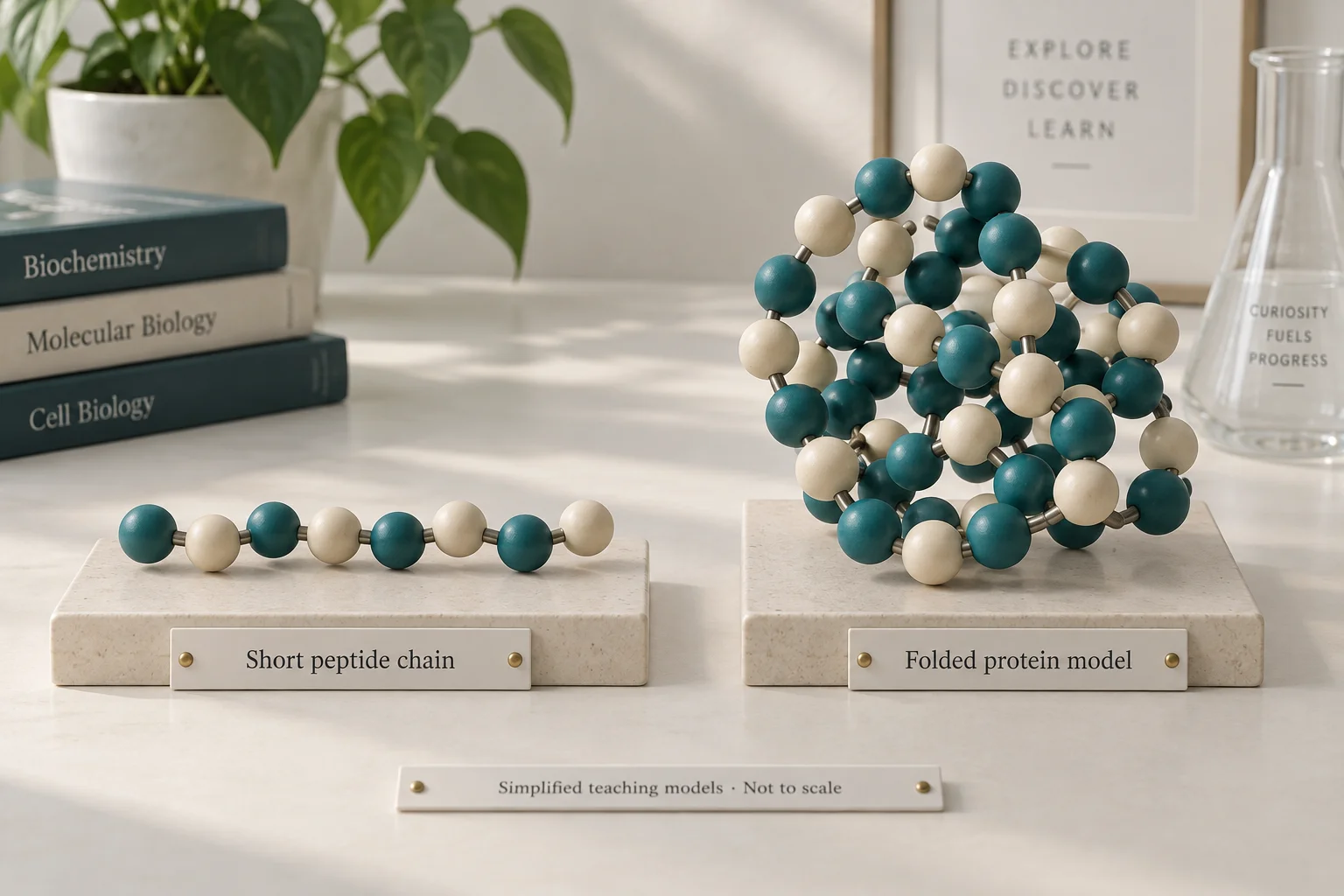
The teaching image uses beads to stand for those units. It does not depict individual atoms, bond angles, or the structure of a named molecule.
Chain length is useful, but not a universal dividing line
NHGRI describes peptides as typically 2–50 amino acids and longer chains as polypeptides. This is an introductory convention rather than a rule that every scientific field applies identically. “Polypeptide” emphasizes the chain; “protein” often refers to a molecule made from one or more chains with a particular structural and functional context.
For research records, write down the named molecule and actual sequence length when supplied. Do not decide that two materials are equivalent merely because both are described as peptides or both have 30 residues.
Sequence: why the order matters
Sequences are conventionally read from the N-terminus toward the C-terminus. Amino acids may be written with three-letter abbreviations or single-letter codes. For example, Gly-Ala-Ser can be written GAS. This is a simple notation example, not a product recommendation.
GAS and SAG contain the same three amino-acid types but in a different order. The examples illustrate why a list of ingredients or a residue count is not a substitute for a sequence. When copying a sequence from a publication, preserve its order and any stated terminal modifications.
Four levels of structure
Primary structure is the amino-acid sequence. Secondary structure describes local arrangements such as alpha helices and beta sheets. Tertiary structure is the overall three-dimensional organization of a chain. Quaternary structure describes the arrangement of multiple chains in a complex. Not every protein has multiple subunits.
Hydrogen bonding, interactions involving side chains, and—in some molecules—disulfide bonds contribute to structure. A folded protein is therefore more than a short chain scaled up. However, a short peptide is not necessarily a straight, featureless string either; the image is intentionally simplified.
Molecular mass is different from sample mass
Molecular mass describes an individual molecule and is commonly expressed in daltons (Da) or kilodaltons (kDa). One kDa equals 1,000 Da. Sample mass describes the amount of material in a container and might be expressed in milligrams. These are different quantities.
As an illustrative distinction, “a 3 kDa molecule” describes molecular size; “3 mg of material” describes a sample amount. Neither number can replace the other in a research record. Residue count alone also cannot specify an exact molecular mass without considering the sequence and modifications.
A comparison checklist for research literature
When comparing two publications, record the molecule’s name, full sequence if given, chain length, terminal modifications, and experimental setting. Also note whether the authors studied a fragment, a full-length protein, or a multi-chain complex.
Consider a paper describing a short fragment from a larger protein. The fragment shares part of the sequence, but the paper does not thereby establish that it has all the structural features or experimental behavior of the complete protein. Keep conclusions attached to the actual material and conditions studied.
Common questions
Are peptides and proteins made from different building blocks?
No. Both are composed of amino acids joined into chains.
Is every polypeptide a complete protein?
The words describe different aspects: a polypeptide is a chain, while a protein may contain one or more such chains.
Is a protein just a larger peptide?
They share amino-acid chemistry, but protein descriptions also involve structural organization and, sometimes, multiple chains. Size alone is an incomplete comparison.
Does the word protein mean a dietary product?
Not in this guide. Here it describes a molecular class in biochemistry and laboratory research.
About our sources and editorial approach
Sources & further reading
These references explain the scientific concepts or documentation practices discussed here. They do not certify or endorse Molecule Works products.
For laboratory research education only. Not for human or animal consumption or administration.