
Laboratory documentation
How to Read a Peptide COA: A Guide to Laboratory Reports
A Certificate of Analysis (COA) records tests and results for an identified sample. Read the identifiers first, then examine the methods, units, and acceptance criteria. A result is meaningful only within the scope of the reported testing.
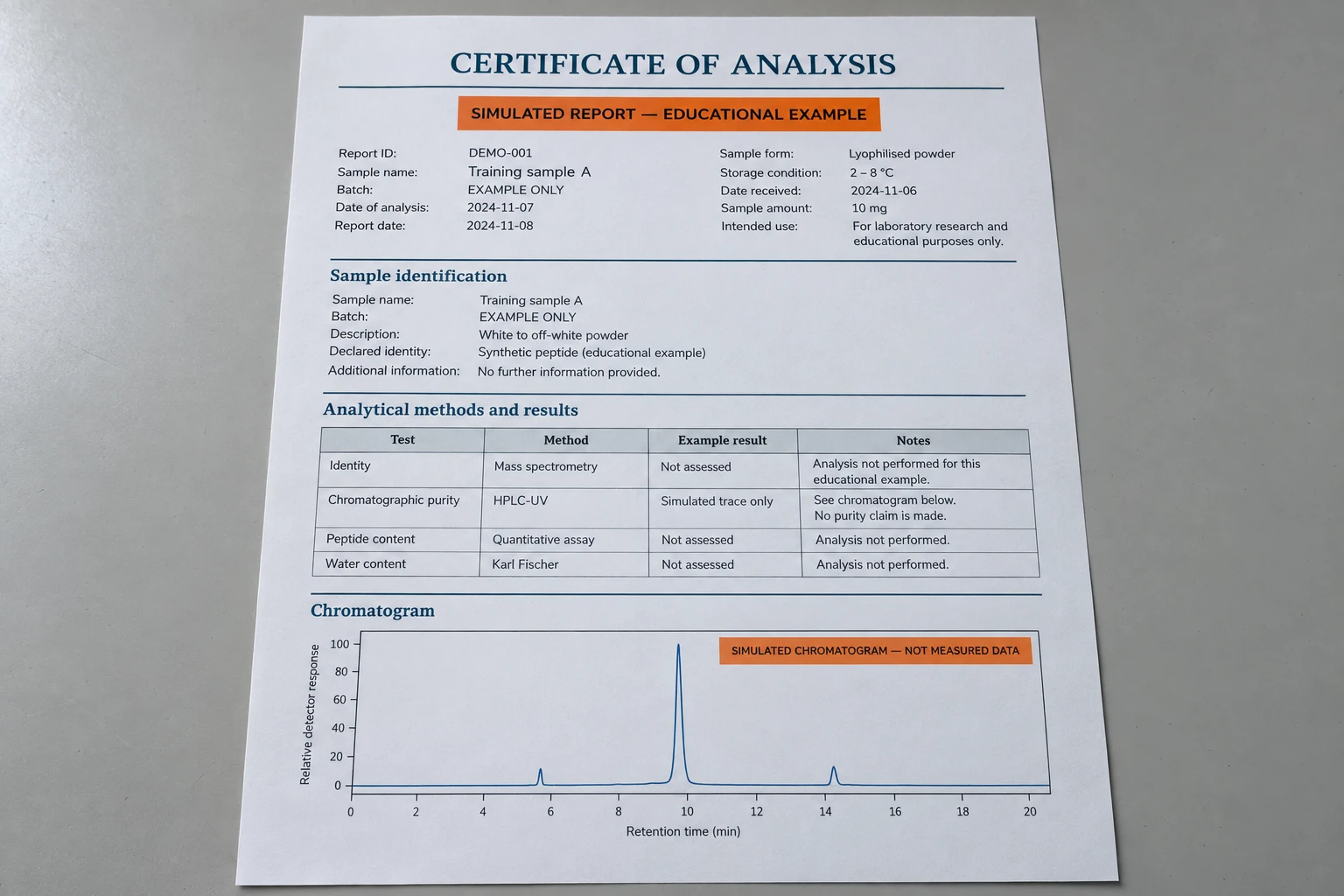
1. Match the report to the actual material
Begin with four identifiers: the material name, the laboratory sample number, the report number, and the batch or lot reference where available. These serve different purposes. The report number identifies the document; the sample number identifies what the laboratory received; the batch number links material to a production lot. A shared product name is not enough to establish that connection.
For example, a report for “Sample A, lot DEMO-01” does not automatically cover a vial labeled “DEMO-02.” This is a fictional traceability example, not information about a Molecule Works batch. If you cannot connect the identifiers, record that gap and ask for clarification.
2. Check the dates and document completeness
Distinguish the sample-received date, analysis date, and report-issue date. They describe different events. An analysis date is not a stability study or an expiry date. Check page numbering, method references, notes, and laboratory authorization details; a cropped screenshot may omit information necessary to interpret the result.
Use a laboratory’s official verification service when one is provided. A matching online report helps verify the document, but does not independently prove that the material in your possession is the sample that was tested.
3. Separate identity, chromatographic purity, and content
Identity asks what the material is. Mass spectrometry can support identity by comparing measured mass information with the expected molecule. A chromatographic result asks a different question: how the sample’s detectable components separate under a particular method.
Peptide content concerns the amount of peptide relative to the total material. Gross dry weight may also include water, counterions, salts, and other components. Therefore, chromatographic purity and peptide content are not interchangeable. A purity percentage alone does not tell you the milligrams of target peptide in a vial.
4. Read a chromatogram without overinterpreting it
The horizontal axis usually shows retention time; the vertical axis shows detector response. A peak marks material detected as it leaves the chromatography column. The integrated area, not simply the peak’s height, is relevant to an area-percentage calculation.
Illustrative arithmetic: if a target peak accounts for 980 area units and the total included area is 1,000, its area percentage is 98%. That is a detector-area ratio for the included peaks—not a demonstration that 98% of the vial’s total mass is the target molecule. Components can overlap in a peak, and method conditions affect what is resolved and detected. The simulated image above is not measured data.
5. Read units and acceptance criteria together
A result in mg, a result in percent, and a mass-to-charge signal answer different questions. Record the unit exactly. “Pass” is meaningful only in relation to a named test and its acceptance criteria. It should not be read as a universal quality judgment.
If a report lists “not detected,” look for the applicable detection limit. If it lists “not tested,” that means no result is supplied. Neither expression should be silently rewritten as zero. Ask the laboratory how an unclear result was defined.
6. Identify what the report does not establish
Do not infer sterility, endotoxin status, stability, or suitability for a particular experiment from a chromatographic purity number. Those are separate questions requiring appropriate evidence. Likewise, results for one submitted sample should not be extended to every vial or future lot without a justified sampling basis.
A useful review note has three parts: “The report identifies…,” “The reported tests show…,” and “The following remains unverified….” This keeps the evidence separate from assumptions.
A specific request when something is missing
Instead of asking only “Is this tested?”, ask: “Which sample and lot does this report cover? What method and units were used for this result? Is the complete report available? How can the report reference be verified with the issuing laboratory?” Save the reply with the report and your material records.
Common questions
Does a COA establish suitability for human use?
No. This guide concerns laboratory documentation; it does not establish suitability for human or animal consumption or administration.
What should I do if the batch reference is missing?
Ask for clarification before treating the report as evidence for a particular batch.
Does 99% chromatographic purity mean a vial contains 99% peptide by mass?
Not necessarily. Detector-area purity, total peptide content, and the mass of a particular peptide are different measurements. Check the stated method and basis of calculation.
Can I compare two purity percentages directly?
Only cautiously. Different methods, detection conditions, and integration rules can produce results that are not directly comparable.
About our sources and editorial approach
Sources & further reading
These references explain the scientific concepts or documentation practices discussed here. They do not certify or endorse Molecule Works products.
For laboratory research education only. Not for human or animal consumption or administration.